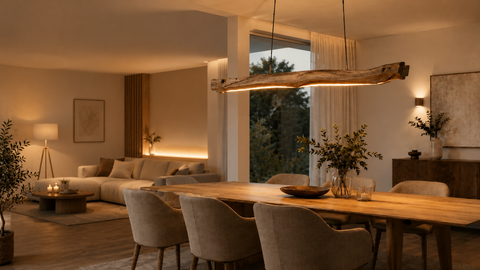
What makes for good lighting?

Good lighting is modeled after natural light. Three characteristics are crucial: color temperature (measured in Kelvin—warm white between 2,700 and 3,000 K creates a cozy atmosphere at the dining table), color rendering (CRI—values of 90 or higher make colors, wood, and food appear natural), and brightness, which should ideally be dimmable. Important: All lights in the same room should have the same light color.
Key Points at a Glance:
- Three quality characteristics: color temperature (Kelvin), color rendering (CRI), and brightness.
- Dining room: warm white, 2,700–3,000 K.
- CRI ≥ 90 = true-to-color, pleasant light.
- All lights in the room: same light color.
- Dimmable = Adjust the lighting to suit the time of day and your mood.
This guide explains what makes for good lighting. The overview “Which Lamp for the Dining Table?” explains exactly which light fixture should hang over the dining table—including its type, length, height, and material.
Good lighting is based on natural light
Artificial light is most pleasant when it resembles natural light as closely as possible. Three characteristics are key to achieving this, and they vary depending on the light source: color temperature, color rendering, and brightness.
Color temperature: warm or cool? (Kelvin)
Color temperature is measured in Kelvin (K) and indicates whether light appears warm or cool. Warm light (2,700–3,000 K) is similar to the light from old-fashioned incandescent bulbs and creates a cozy atmosphere. Cool light (over 3,300 K) has a bluish tint and has a more neutral feel. Daylight also varies: the midday sun is around 5,500–6,500 K, while the evening sun is around 3,000 K.
| Color Temperature | Effect | Deployment |
|---|---|---|
| 1,800–2,200 K | very warm, atmospheric | Accent lighting, retro light bulbs |
| 2,700 K | warm white, classic and cozy | Dining room (recommended) |
| 3,000 K | warm white, slightly cooler | Dining room, open-concept and modern (recommended) |
| starting at 3,300 K | neutral to cool white | Work/Functional Lighting |
For the dining table, warm white light between 2,700 and 3,000 K is the coziest choice—whether you prefer a classic warm tone or something a touch fresher is a matter of taste. For those who prefer a particularly atmospheric feel: Retro bulbs with approximately 1,800 K produce a light almost as warm as candlelight—deliberately warmer than the classic recommendation, but popular among lovers of very warm light (our LED retro models are designed with this in mind). There are also bulbs with adjustable color temperature that mimic the course of the day—but for dining and social gatherings, warm white remains the classic choice.
One light color per room
If you mix lights with vastly different color temperatures in a room, the result looks unnatural and is uncomfortable to the eye. Therefore, make sure that all lights in a room have the same light color.
Color Rendering: Why CRI Matters
The Color Rendering Index (CRI) describes how faithfully a light source renders colors. A value close to 100 most closely resembles sunlight and is perceived as particularly pleasant—light sources with a CRI of 90 or higher are recommended. This is especially important above the dining table: High color rendering makes the grain of real wood and the colors of the food appear vibrant and natural.
Light and Body: Blue—Alert; Warm—Relaxed
Light affects our circadian rhythm. Blue, cooler light suppresses the sleep hormone melatonin and promotes serotonin—it helps us wake up in the morning and improves concentration. Warm light with a high proportion of yellow and red has a calming effect and promotes restful sleep in the evening. Warm light is therefore the better choice for the dining room in the evening.
It’s not just the color of the light that affects the body, but also glare: If the light source is directly in the field of vision of those seated, it causes eye strain—and above the dining table, it also interferes with eye contact. The key factor here is the hanging height, which you can read about in the guide “Height & Distance of the Dining Table Light.”
Brightness throughout the day: dim
The brightness of daylight also changes: At noon, we prefer bright light; in the evening, we prefer subdued light. With a dimmer, you can adjust the brightness at any time to suit the time of day, your activity, and your mood. To find out exactly how much light is needed and what lumens and lux mean, read the guide “Brightness, Lumens & Lux.”
Frequently Asked Questions
What is the ideal light color for above the dining table?
Warm white light between 2,700 and 3,000 Kelvin—it creates a cozy and inviting atmosphere.
What does CRI (Color Rendering Index) mean?
The CRI indicates how faithfully a light source renders colors. Values of 90 or higher are considered high quality and make colors, wood, and food appear natural.
What is the difference between warm white and cool white light?
Warm white light (below approx. 3,300 K) creates a cozy atmosphere, while cool white light (above that) appears bluish and neutral.
Should all the lights in a room have the same color of light?
Yes. A wide mix of color temperatures looks unnatural and is jarring to the eye.
Why should lighting be dimmable?
So you can adjust the brightness to suit the time of day, your activity, and your mood—bright for working, dimmed for a cozy evening.
To go with this: our handcrafted dining table lamps made from genuine oak branches with warm white light—each piece is one-of-a-kind.